

Views: 0 Author: Site Editor Publish Time: 2026-10-17 Origin: Site


Buyers should approve a custom cat tree sample only after checking the complete assembled product, its materials and finish, the applied branding, the assembly instructions and the final packed unit against the agreed specification. Structural fit and missing parts deserve attention before cosmetic details; unresolved changes should lead to revision or a clearly limited conditional approval.
A showroom-ready prototype and a production-ready sample can look similar. The review needs to establish which components, construction methods and packaging the factory will reproduce, with any temporary sample features identified before the bulk order proceeds.
Identify the sample before inspecting it: model, drawing revision, material list and whether it was made with the intended production components. Ask the supplier to flag hand-fitted joints, substitute fabric, temporary fasteners or unfinished packaging. These exceptions help explain what the current sample can demonstrate and what needs another review.
The market brief should then guide the inspection. A boutique display model needs a suitable footprint and a consistent furniture finish; an e-commerce model also needs clear packed assembly and product photography that matches the delivered version. Judge these channel requirements directly instead of treating a premium appearance as proof of saleability.
Confirm assembled dimensions, base footprint, platform spacing and intended cat-size range against the drawing.
Specify indoor use in the product information. Yugie cat furniture is not suitable for outdoor use.
Identify which colors, heights or accessories the sample represents; keep unreviewed variants outside its approval scope.
Unpack the sample and have a team member assemble it using the proposed customer instructions, supplied tools and actual hardware pack. Record where assistance from the product developer was needed. An already-assembled sample can conceal reversed parts, ambiguous diagrams and fasteners that are difficult to reach.
Count every panel, post, cushion, fastener and accessory against the parts list. Check that similar-looking components have useful identifiers.
Check hole alignment and fastening access. Note joints that require forcing, redrilling or replacement hardware to fit.
Inspect connections after correct assembly: platforms should seat as designed, posts should attach securely, and visible gaps should match the agreed construction.
Check the base on an appropriate level surface and note rocking, uneven feet or movement at individual joints. Record the location and assembly conditions for supplier review.
Inspect accessible edges and hardware for splinters, burrs, protruding screws or staples. Check detachable components and any securing hardware against the actual instructions.
Measure the assembled height, width, platform positions and usable resting areas. Compare the results with the agreed dimensions and tolerances.
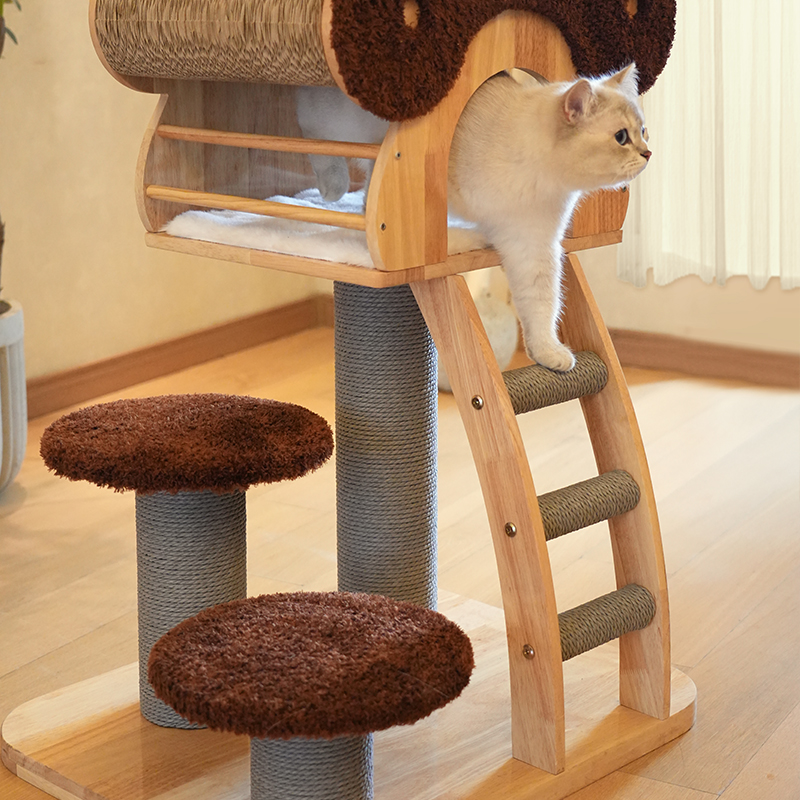
Mushroom cat tree detail showing ladder fixings, wrapped rungs and fabric-covered resting platforms.
Fit checks and performance tests answer different questions. A joint that assembles cleanly has not thereby demonstrated its load capacity or long-term durability. Ask the cat tree manufacturer for the proposed stability, load and durability methods for this exact configuration, including conditions, acceptance criteria and any matching reports. Have qualified technical personnel resolve these requirements; do not improvise destructive tests or borrow a weight limit from another model.
For example, if a supplied bolt bottoms out before a post tightens, record the part and joint involved rather than simply asking for a stronger tree. A hardware correction can affect the parts list and assembly instructions as well as the physical sample.
Compare the physical components with the material list, approved swatches and finish references. “Solid wood” does not describe every part of a mixed-material product. Yugie’s solid wood cat-tree construction can combine rubberwood, plywood, paper columns and sisal rope; its metal cat trees combine carbon steel, solid wood and fabric.
Component checks for the selected sample
Component | What to examine | What to confirm with the supplier |
|---|---|---|
Wood and plywood parts | Surface defects, edge condition, warping, visible joints and hole positions | Which parts are rubberwood or plywood; specified dimensions, finish and permitted variation |
Posts and scratching surfaces | Post-end fit, wrapping gaps, loose rope ends and consistency of the scratching surface | Post construction and exact rope type; attachment and replacement method if offered |
Steel frame and connectors | Burrs, accessible weld areas, coating coverage and hardware fit | Frame material, finish, connector specification and any securing requirements |
Fabric and cushions | Seams, attachment points, color, texture and fit on the platform | Fabric specification, removable parts and supported cleaning instructions |
Glass, when included | Visible chips or cracks, edge condition, fit and contact with adjacent components | Tempered-glass specification, mounting arrangement and matching material documentation |
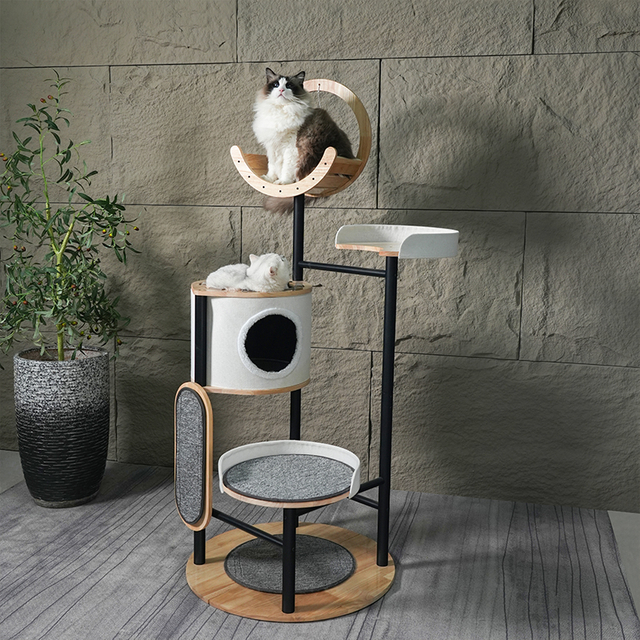
Lively cat tree combines a dark frame, wood platforms and fabric-covered resting areas.
Glass and enclosures: Glass is a product-specific check. Yugie cat villas generally use rubberwood, plywood, tempered glass and carbon steel; that combination should not be assumed for every cat tree. If an OEM cat tree concept adds glass or an enclosure, include those actual components in the review and obtain the corresponding technical requirements.
Finish consistency: Inspect finish color and sheen under consistent lighting alongside the approved reference. Agree how natural wood-grain variation will be handled, and distinguish an acceptable variation from mismatched stain or incomplete coating. Odor and appearance can flag a concern but cannot establish chemical compliance.
For the US market, the EPA composite-wood FAQ identifies hardwood plywood, MDF and particleboard as covered product types under its formaldehyde rule. Ask qualified compliance personnel which requirements apply to the selected panels and obtain the relevant supplier documentation before relying on a compliance claim.
Review the logo on the finished product, not only in artwork. Check placement, size, contrast and application quality where the mark will actually appear. An engraving on wood and a printed fabric label can need different artwork treatment, so approve the chosen method as part of the custom cat tree design.
For a designer cat tree intended for boutique display, inspect the assembled unit from the normal viewing angles and beside the brand’s intended fixtures or finish references. Check whether cushion color, wood tone and metal finish support the same collection identity. Online photography should show the supplied configuration rather than accessories excluded from the order.
Match model identifiers across the product label, instruction sheet and carton artwork.
Read the assembly and care wording in the required language; verify indoor-use information and technical instructions with the responsible specialists.
Check retail packaging for the correct logo file, product image, component description and scannable identification where required by the channel.
Ask to inspect the production-ready unit in its proposed shipping packaging. Opening a courier sample is useful for spotting damage, but a successful arrival is not evidence that the final carton suits every distribution route. A cat furniture supplier should explain how the product, loose components and hardware will be protected in the agreed packing arrangement.
Look for movement inside the pack, exposed corners and wood-to-metal or glass-to-hardware contact that could damage surfaces.
Confirm that hardware is contained and that all accessories can be located without discarding an insert by mistake.
Check the parts and instructions after unpacking, then confirm the product can be repacked using the intended arrangement.
Measure final carton dimensions and gross weight; match model, quantity, shipping marks and required channel labels.
Have the packaging specialist and logistics provider agree suitable packaged-product verification for the actual route and handling conditions.
Yugie offers export cartons, retail color boxes, custom brand packaging and protective packaging for Amazon FBA shipments. Select the option for the intended channel and check its current requirements separately. A later insert or carton change can alter packed dimensions, so confirm freight assumptions using the final pack rather than the initial quotation.
Give the supplier a specific decision that separates what is accepted from what still needs correction. A visually acceptable sample with an unresolved joint problem should not receive the same decision as a complete unit awaiting a minor carton-artwork edit.
How to decide after reviewing the sample
Decision | When it fits | What the buyer should specify |
|---|---|---|
Approve | The sampled configuration, required verification, branding and packing meet the agreed requirements | Identify the accepted sample and coordinated drawing, materials, artwork, instructions and packing versions |
Revise and review again | A material, joint, assembly, functional or packing issue remains unresolved | Describe the observed problem, affected component and required recheck; obtain a corrected sample where the change needs physical verification |
Limited conditional approval | A clearly bounded correction does not change the accepted structure, material or verified function | State the precise correction and evidence needed, who accepts it, and what work may proceed; keep final approval pending until it is closed |
Artwork correction: A spelling correction on a carton can be checked on a revised print proof when dimensions and protection stay unchanged.
Physical change: A larger platform or different post material needs review of its physical and downstream effects, including structure, assembly and packing.
Do not use conditional approval to bypass unresolved safety or compliance questions.
Keep a protected physical reference and the matching specifications available to buyer, factory and inspector. Agree acceptable variation where a single sample cannot show it, and require approval of material or construction substitutions. This gives a pet furniture manufacturer something reproducible for bulk work; the approved sample alone does not verify a production lot.
Yugie’s customization process includes sampling and adjustments before approval, followed by mass production. Its services describe woodworking, metal-processing and upholstery machinery, with inspections across production stages. Ask how the accepted configuration will be transferred into the production instructions and inspection criteria for the actual order.
They can support review of appearance and reported checks, but they do not let the buyer inspect packed contents, material feel or assembly firsthand. If a physical review is unavailable, identify the remaining uncertainty and arrange appropriate independent inspection rather than treating photographs as equivalent.
There is no fixed number that suits every project. Separate concept samples from production-ready samples and plan another round when a correction affects material, structure, fit or packing; confirm the schedule for the actual changes.
Yugie’s services state that sample fees can be refunded or deducted after a bulk order. Confirm the applicable order value, deduction method and exclusions in the quotation before paying for the sample.
No. Yugie gives a typical production period of 30–45 days depending on quantity and customization; that is not the complete sampling-to-arrival timeline. Confirm when production timing starts, the effect of outstanding corrections and the separate shipment schedule.
Only to the extent that its construction and variations are clearly defined. For wholesale cat furniture in several heights, materials or layouts, identify the shared features and have the supplier explain which variants require separate samples or technical verification.
Close the sample review with specific corrections and an agreed next step. To discuss the next sample with Yugie, send the model reference, marked photographs, required changes, proposed quantity, sales channel and destination so the team can confirm the sampling and production implications.
Use the completed sample checks to agree the next sampling or production step with Yugie before committing to bulk manufacture.


