

Views: 0 Author: Site Editor Publish Time: 2026-10-15 Origin: Site


Pet brands can develop a coordinated custom cat furniture collection by defining shared design rules, assigning complementary roles to each SKU, and agreeing which parts can be standardized. Review the full series together, then align model quantities, packaging and replacement support before bulk production.
The result should be recognizable as one family while giving retailers useful differences to sell. Coordination must extend beyond a matching color: function, manufacturing decisions and product information all need to work together.
Start with a short collection brief that states the intended indoor setting, retail channels, price positioning and visual character. Validate that direction with distributor feedback, retailer assortment gaps and actual order enquiries. A request for “premium modern furniture” leaves too many decisions open; an agreed palette, silhouette and material treatment gives the factory something concrete to develop.
Choose a limited wood-tone and metal-color palette, with physical reference samples rather than screen images alone.
Repeat a recognizable shape: a platform outline, frame curve or leg detail that can appear at different scales.
Specify textile texture, scratching-surface appearance and logo placement as part of the family.
Allow controlled differences in height, footprint and function so each model has a reason to exist.
For example, an illustrative range could combine warm wood tones, dark steel details and rounded resting surfaces. A compact tree and a larger enclosed model can share those cues without sharing every material or part. Ask the cat tree manufacturer to show the proposed products together in one view, then compare them without relying on logos. If the connection disappears when the branding is hidden, strengthen the product design before adding more variants.
Build the first assortment around complementary jobs. A size ladder is useful when each size serves a different space or channel; several nearly identical towers can spread the opening order too thinly. Use a role matrix before commissioning drawings.
Illustrative roles for a coordinated indoor collection
Proposed role | What it contributes | What should stay distinct |
|---|---|---|
Compact tree | An accessible entry to the collection and a smaller display option | Footprint and climbing layout |
Vertical tree | A taller climbing and resting format | Platform arrangement and structural design |
Cat villa | An enclosed furniture expression within the same visual family | Glass, access and enclosure construction |
Replacement or accessory items, if feasible | Support for the products already sold | Verified fit and clear model compatibility |
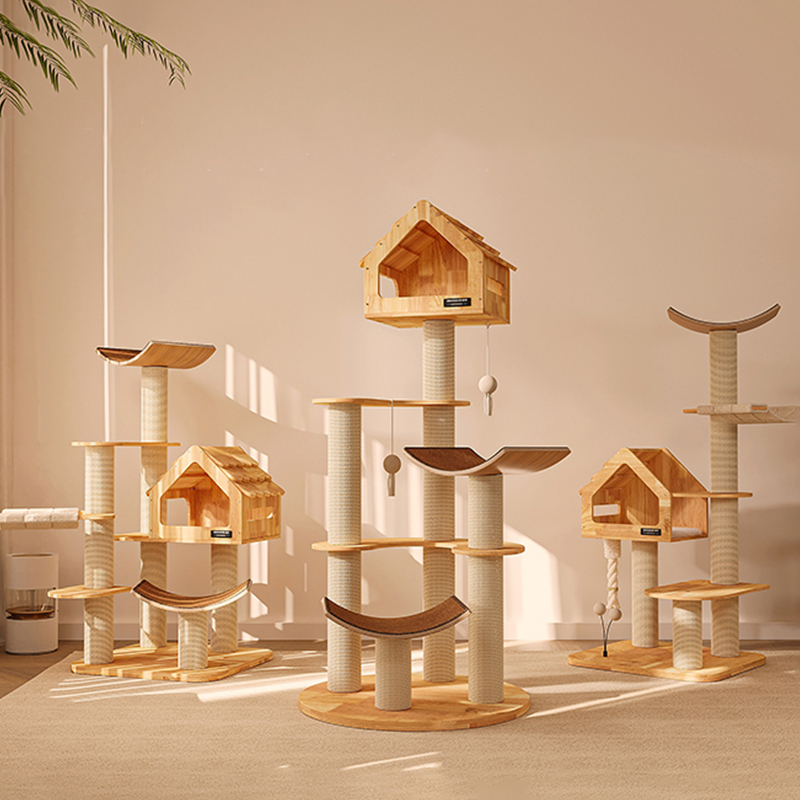
Forest Series variants share wooden houses, curved platforms and wrapped scratching posts.
This is a planning example, not a promised catalog combination. Set a target buying quantity and channel for every proposed SKU, then challenge duplicates. If two products have the same function, footprint and price position, explain why both are needed or remove one. For wholesale cat furniture, a coherent smaller launch can be easier to replenish than a broad assortment with little stock behind each model.
Visual coordination does not require an identical bill of materials. Yugie’s product families use different constructions:
Cat villas generally combine rubberwood, plywood or multilayer panels, tempered glass and carbon steel.
Solid wood cat trees may combine rubberwood, plywood, paper columns and sisal rope.
Metal cat trees combine carbon steel, solid wood and fabric.
Confirm the exact construction for each selected model; rope options vary. Coordinate the families through agreed wood tones, steel finishes, textile colors and recurring shapes.
Keep the material schedule specific: a similar-looking platform can use a different panel construction, and a fabric shade can look different beside glass or coated steel. Review actual samples together under the same lighting rather than accepting separate photographs as a color match.
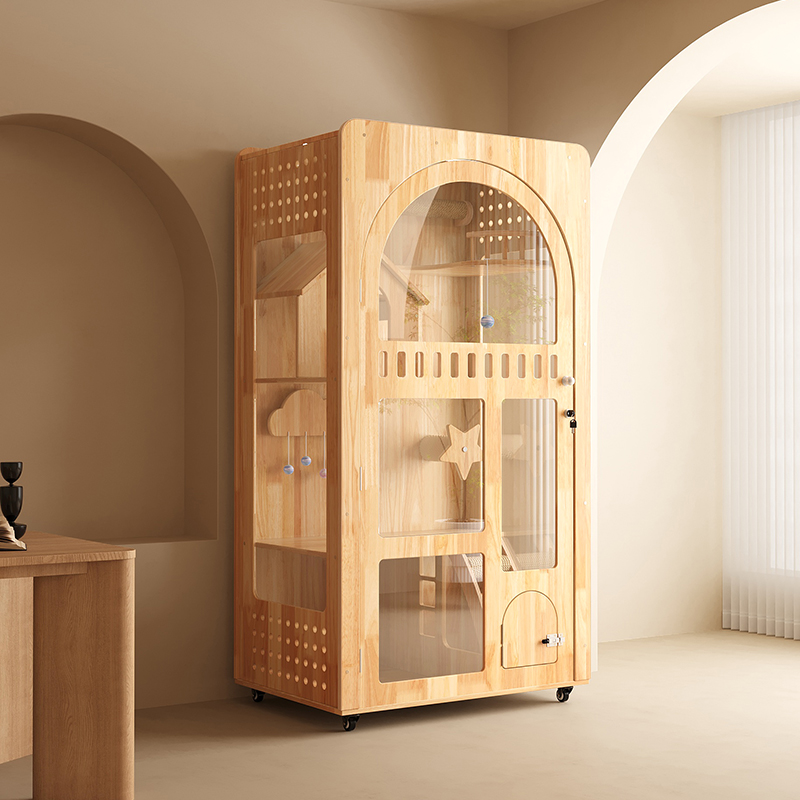
Wooden panoramic cat villa with transparent front panels, internal platforms and wheeled base.
Ask the pet furniture manufacturer which hidden parts can be shared. Candidates might include compatible fasteners, cushion sizes or scratching components, subject to engineering review.
Record each proposed common part, the models using it and the dimensions or connections that must stay unchanged.
Balance simpler purchasing and spare stock against the extra part codes, sourcing choices and sample work introduced by further customization.
Do not standardize a base, post or connector simply to reduce the part count. A taller model or glass enclosure can need a different structural solution. Ask for model-specific evaluation of stability, joints, access and assembly before accepting the design.
These collections are for indoor use and are not suitable for outdoor use. Matching the collection’s appearance does not establish weather resistance.
For an OEM cat tree project, individual sample approval should sit inside a series review. One attractive prototype does not show whether the rest of the range matches it, assembles clearly or uses the agreed parts. Separate appearance decisions from model-specific construction decisions.
Agree the family references first: wood tone, steel color, fabric, scratching finish, shape details and branding. Identify which are fixed across the collection.
Review each model’s drawings and parts list against its intended role. Resolve proposed common parts before ordering all prototypes.
Compare a sample of each launch model side by side. Check finish relationships, proportions, supplied components and assembly instructions; review structural concerns with the manufacturer.
Record changes by model and by shared part. If a connector, cushion or finish changes, identify every affected SKU and recheck those samples.
Retain the approved samples and the matching drawings, parts lists and packaging versions as the references for bulk orders.
Yugie describes an OEM/ODM customization process covering consultation, design proposal, sampling, confirmation, mass production and delivery. Its services include size, color, material, logo and packaging options. Use that scope to discuss a series brief, while agreeing the number of sample rounds and their costs for the actual project.
Existing products can also be starting points: Yugie’s Forest Series lists six models with different heights and layouts. A designer cat tree family can therefore be evaluated for coordinated variants before requesting a completely new structure. Matching styles do not imply identical holes or fasteners. Confirm the exact common components when selecting the development route.
Treat the opening order as a set of model-level commitments. Most standard Yugie products generally start at 30–50 pieces per model; customized products can require higher quantities depending on materials and production complexity. Do not assume a mixed collection total satisfies every minimum.
As an illustration, three standard models ordered at 40 pieces each create a 120-piece assortment, if the supplier accepts those model quantities.
Check finish and packaging minimums: adding colors can create further buying commitments, so ask whether the minimum applies by model, finish or packaging version.
Consider a phased launch: begin with the strongest complementary roles and add another SKU after channel feedback, subject to the agreed commercial terms.
Yugie states that bulk production typically takes 30–45 days depending on quantity and customization; repeat standard orders may be shorter. That period is not the complete concept-to-delivery schedule. Allow separate time for development, revisions, material decisions, packaging preparation and freight.
The supplier describes woodworking, metal-processing and upholstery machinery. Before setting a retail launch date, agree how those operations will support the range:
Confirm the production schedule for the chosen models and identify components that could constrain replenishment.
Ask whether models can be completed or shipped in stages.
Agree how a delayed custom cat tree affects the rest of the order.
Packaging should make the family recognizable while keeping each SKU unmistakable. Use consistent typography, product photography and visual hierarchy, with a prominent model name, finish code and parts list. The outer appearance can match; protective inserts and carton dimensions should follow each model’s construction, especially when glass and steel are involved.
Yugie offers export cartons, retail color boxes, branded packaging and protective Amazon FBA packaging. Select the format for the sales route and confirm the current marketplace requirements separately. Ask for packed samples and a packaging evaluation suited to the handling and delivery route rather than assuming one carton solution covers the range.
Give retail partners a consistent collection name and a comparison of functions, dimensions and finish choices for each model.
Plan a display that shows the shared design details while making compact, taller and enclosed options easy to distinguish.
Use matching photography angles and scale references across listings; show each model’s actual contents.
Agree replacement-part identifiers, compatible models, ordering quantities and availability before promoting replaceability.
When a part changes, update instructions and compatibility information, and agree support for earlier versions.
A cat furniture supplier should also clarify how spare items will be packed and supplied with replenishment orders. Where a finish or component is discontinued, decide whether an alternative needs a new SKU or can serve an earlier model. This keeps a later range extension from quietly breaking the support promise made at launch. Revisit the assortment using retailer feedback and stock movement, then add or retire models for a clear reason.
Yes, this is a possible sourcing approach to discuss. Compare the existing models against the same design rules, then confirm separate minimums, sampling needs and production schedules for the customized items; a shared launch date needs an agreed plan.
No. A villa and a tree can share finish tones and shape details while using different constructions. Identify the exact materials in each SKU’s product information so the collection identity does not imply a uniform specification.
Define the designs, markets, channels, period and modifications covered by the proposed arrangement. Yugie can discuss patents or exclusive agreements for custom projects; that does not establish automatic buyer ownership or worldwide protection. Have the proposed terms reviewed for the intended markets.
Provide the intended model roles, reference images or drawings, quantities per model, finish choices, customization scope, packaging needs and destination country. Request separate sample, tooling or development costs where applicable, plus agreed production timing and trade terms.
Agree how damage will be reported by model and carton, what evidence is required, and who pays replacement freight. Yugie’s services describe replacement or compensation for confirmed transit damage and optional shipping insurance; confirm the claim conditions for the order rather than treating these as an unrestricted warranty.
Start with a collection brief small enough to manage: one visual direction, a clear role for each launch SKU, shared-part decisions and a plan for later replacements. Before committing to a broader range, resolve the choices that affect several models at once. Brands can discuss collection requirements with Yugie once those model roles and quantities are defined.
Send Yugie the proposed SKU list, design references, quantities, packaging requirements and destination to discuss samples and a collection-specific quotation.


