

Views: 0 Author: Site Editor Publish Time: 2026-10-12 Origin: Site


Private label fits a business ready to brand an existing cat furniture model. ODM fits a brand that needs supplier design input or adaptation. OEM fits a buyer bringing its own design and specifications. A phased combination can work when channel demand is still being tested.
These are practical sourcing descriptions, and suppliers use the labels differently. Choose by the actual design, development and supply responsibilities in the proposal. Branding, design ownership and exclusivity are separate questions, whichever label appears on the quotation.
In this comparison, OEM means manufacture based on a buyer-led design; ODM means supplier-led design or adaptation; private label means selling an existing supplier product under the buyer’s brand. An OEM cat tree project can still need factory engineering, while an ODM project can include substantial buyer direction.
Typical program scope: compare responsibilities before choosing a label
Decision axis | OEM: buyer-led design | ODM: supplier-led design | Private label: existing model |
|---|---|---|---|
Buyer design input | Drawings, dimensions, materials and performance requirements | Market brief; supplier develops or adapts a design | Select a model; supply logo, artwork and allowed options |
Design ownership | Separate buyer assets from factory engineering; agree new-work rights | Agree rights to existing designs and newly developed changes | Agree rights to the underlying catalog design separately from branding |
Development effort | Engineering review, prototypes and possible production aids | Concept work or adaptation, followed by samples | Usually less product development if structure is unchanged |
MOQ | Depends on unique components, materials and production setup | Depends on adaptation depth and component sourcing | Existing components can make smaller runs more practical; confirm per model |
Branding | Specify logo method, location and brand treatment | Integrate brand treatment during development | Use agreed label/logo locations on the selected model |
Packaging | Product and carton development may both be needed | Revise carton protection when size or structure changes | Artwork and retail/shipper choices can still create extra work |
Exclusivity | Write the design, territory, channel and duration terms | Write which version or changes are reserved | Often shared design unless a restriction is specifically agreed |
The distinction between ODM and private label is especially fluid. A supplier may call catalog rebranding ODM, while another reserves ODM for a new concept. Ask what design already exists, what work the supplier will perform, and what the buyer receives. Compare quotations using those answers rather than assuming identical scope.
Development costs should also be separated: engineering and samples, tooling or production aids, product units, branded packaging and any testing requested. A lower unit quotation can accompany a larger upfront commitment. None of the three models guarantees the lowest overall cost.
Match the program to design readiness and the reason the channel needs a different product. The following situations are illustrative business choices, not promised launch results.
Retailer adding a first own-brand collection: private label is a sensible starting point if an existing structure fits the assortment. Put effort into model selection, consistent presentation, instructions and carton artwork. Accept that another brand may carry the same underlying shape.
Brand with a clear brief but no product designer: ODM fits when the brand can define the footprint, style, target cost and channel needs but needs the supplier to develop the structure. Budget for design decisions, sample revisions and a clear agreement about the resulting design.
Established brand with its own product design: OEM fits when drawings and material requirements are sufficiently developed for factory review. It offers more direction over the product concept, but the buyer must resolve engineering questions and fund any agreed new components or tooling.
Market demand should determine the depth of customization. For wholesale cat furniture, ask retail partners which footprints fit their displays, which finishes belong in the assortment and which assembly questions recur. For an online channel, compare how dimensions, materials and packed size can be communicated. A new silhouette is useful only if it serves a channel need; color and presentation may already meet that need.
A hybrid path can start with one existing model and branded packaging, use retailer feedback to guide an ODM adaptation, and later develop an OEM-led design when the brand has the resources. Carry forward useful dimensions, assembly feedback and packing lessons.
Treat each changed version as a fresh specification: its minimum quantity, sample work, packaging and rights can differ. Choose this path when learning is valuable; start with OEM when a unique structure is central to the launch.
Write design rights separately from the order’s OEM, ODM or private-label heading. Paying for a sample or production aid does not, by itself, explain which drawings can be reused or who may sell the finished design. A cat furniture supplier should be able to discuss the requested commercial scope before development starts.
Identify pre-existing supplier designs, buyer-provided drawings and new work created for the project.
Specify access and permitted reuse of design files, tooling, artwork and instructions.
Define exclusivity by model or version, sales territory, channel and duration, including any volume conditions.
Agree confidentiality, permitted subcontracting and what happens to files or tooling if cooperation ends.
WIPO explains that industrial design rights are territorial: protection is limited to the country or region where it is granted. A supplier’s patent claim therefore does not establish worldwide protection or buyer ownership. Obtain qualified advice for the intended markets and put the agreed commercial restrictions in writing.
Changing a platform, joint or panel is product development, even when the quotation calls it customization. A logo change can leave the structure intact; moving a high platform, changing a base or adding glass changes what the manufacturer needs to evaluate.
Discuss stability, connections and packing together rather than judging a custom cat tree only by its rendering.
Yugie’s solid wood cat trees may combine rubberwood, plywood, paper columns and sisal rope. Metal cat trees combine carbon steel, solid wood and fabric. Use a designer cat tree from the relevant construction family as the starting reference, then specify which components are retained or changed. Rope options vary by model; the material for one scratching surface should not be assumed for the whole collection.
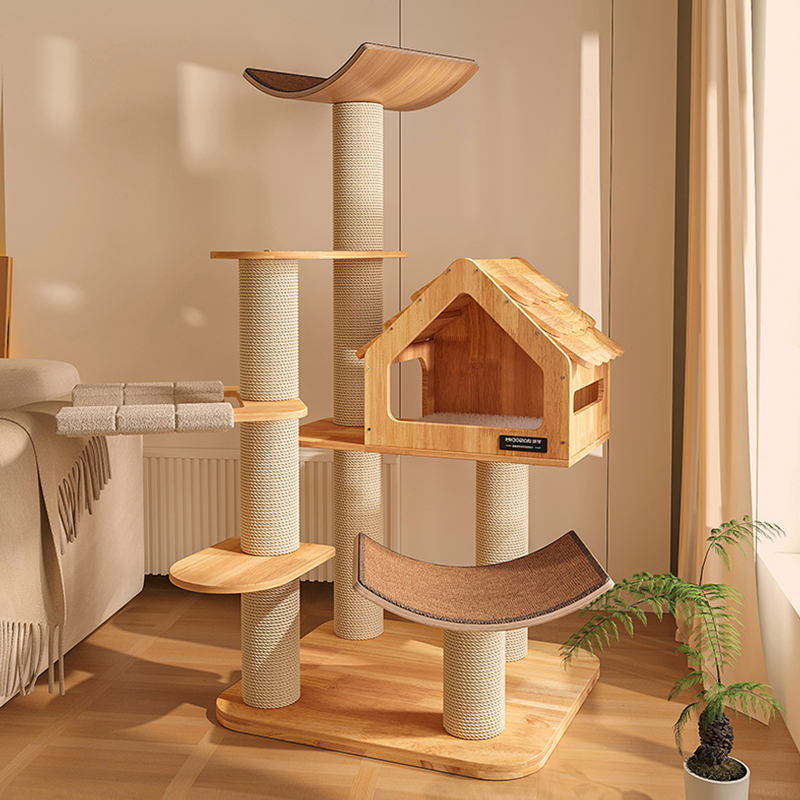
Wood cat tree with rope-wrapped columns, stepped platforms and an enclosed resting space.
Cat villas generally combine rubberwood, plywood or multilayer panels, tempered glass and carbon steel. Wood surfaces and glass panels can contribute to a furniture-like appearance, while their joints, fittings and finish need careful specification.
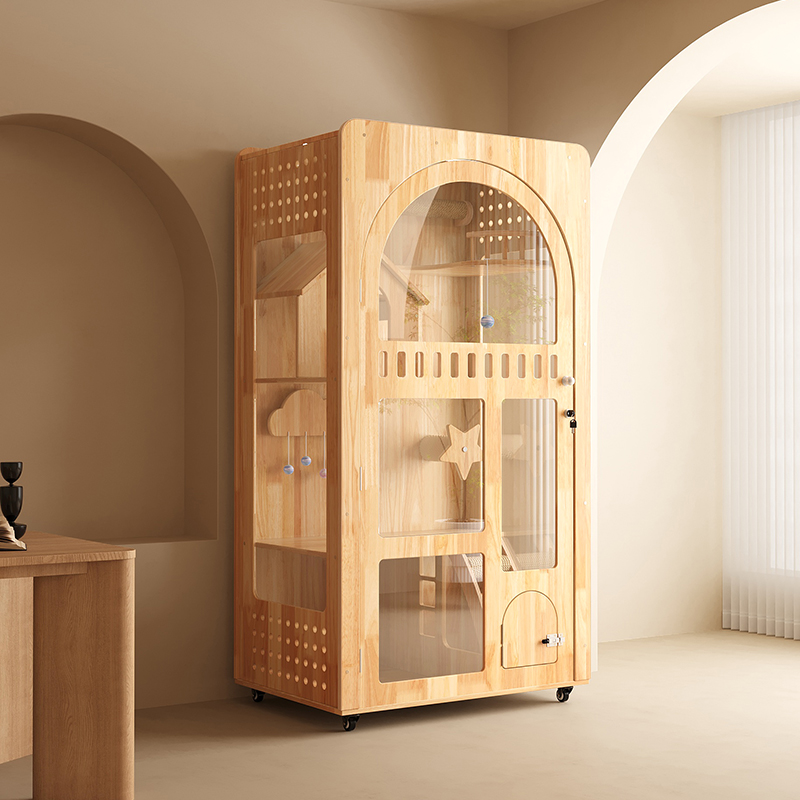
Wood and glass cat villa with an enclosed vertical layout and clear front panels.
Request a sample assessment of panel fit, exposed edges, door movement where applicable, hardware and assembly instructions. These are procurement checks, not a substitute for appropriate structural or material testing. Yugie products are for indoor use and are not suitable for outdoor use.
Yugie describes OEM/ODM customization services covering size, color, materials, logo branding and packaging. Its published process includes design proposals, sampling, revisions and bulk production, supported by woodworking, metal-processing and upholstery equipment.
Ask the pet furniture manufacturer which operations it will handle for the selected design, how sourced components will match the sample and how any material substitution will be agreed. This connects the design choice to repeatable supply.
Compare quantity, timetable and delivery scope for the actual configuration. An OEM, ODM or private-label heading does not settle these commitments.
Yugie states that most standard products generally start at 30–50 pieces per model; customized products can require more depending on materials and complexity.
Compare the minimum for the actual configuration, not just the label. An existing structure with a special fabric or branded carton can have a different commitment from the standard version.
The stated production time is typically 30–45 days, depending on quantity and customization; repeat standard orders may be shorter. Keep concept development, sample revisions, production and international transit as separate parts of the plan.
Ask the cat tree manufacturer to confirm the production slot for the selected model and quantities, including the effect of late changes. A catalog item is not automatically available for immediate shipment.
Packaging options include export cartons, retail color boxes, branded packaging and protective packaging for Amazon FBA shipments. Define the requirements alongside the product:
Route and carton data: specify the intended route, packed dimensions and weight.
Component protection: specify glass separation where relevant, protection for other components, hardware organization and instructions.
Fulfillment requirements: check the current requirements for the destination; an FBA packaging option is not automatic compliance.
Yugie offers EXW, FOB, CIF or DDP arrangements subject to the agreed order and destination. Compare quotations at the same delivery point, with packaging, freight and responsibilities clearly itemized.
Use them to explain desired dimensions, styling or functions, alongside an original brief. Ask the supplier to develop a suitable concept rather than copy another brand’s product, and obtain rights advice if the reference creates uncertainty.
Ask for this explicitly. A per-model minimum does not establish that every color, material or printed carton can share that quantity; request a breakdown by option and identify any separate component or packaging minimums.
Yugie’s services state that sample fees can be refunded or deducted after a bulk order. Confirm the eligible order, amount and conditions in the quotation, and ask whether revisions or special components carry separate charges.
Agree claim information, remedy, freight responsibility and timing before ordering. Yugie states that confirmed quality issues can receive free replacements and confirmed transit damage can receive replacement or compensation; confirm the scope for the specific order rather than promising an automatic consumer warranty.
Do not assume that it can. Discuss usable drawings, material specifications, tooling access and permission to reuse each asset at the outset; a new supplier would still need to assess manufacturing and packing for its own process.
Set out what already exists, what needs development and which rights the brand needs before requesting a proposal. Send reference models or drawings, quantity by configuration, branding and packing needs, destination and intended channel to discuss the project scope with Yugie.
Ask for a proposal that separates the selected sourcing model, development work, production quantity, packaging and delivery terms.


