

Views: 0 Author: Site Editor Publish Time: 2026-10-07 Origin: Site


Low-MOQ cat furniture helps brands test a new market by limiting the inventory committed before real sales and delivery feedback arrive. A smaller batch can show whether a product, price and channel deserve another order, while leaving less unsold stock if the proposition needs changing.
The benefit depends on a focused test. Too many models, unclear sales exposure or an expensive shipping plan can make a small order difficult to interpret. Brands need a defined question, a complete cost budget and a follow-up decision before the first batch ships.
Choose one destination, one sales channel and one product proposition. A brand entering a country through independent pet boutiques needs different evidence from a brand testing its own online store. Combining both in the opening batch makes it harder to tell what caused the result.
Hypothesis: state which offer is expected to work, for which channel and at what intended price.
Exposure: agree how the product will be listed or displayed, how stock availability will be tracked, and who supplies sales data.
Test window: set the selling period and a later review point for returns and support issues.
Decision criteria: set acceptable sales progress, total spending and service workload using the brand’s budget and channel experience.
For illustration, a brand might test whether a compact wood cat tree sells at its intended price through boutiques in one country during a six-week period. That is a hypothetical test, not a recommended duration or sales target. Keep price and display conditions reasonably consistent; record promotions or stockouts that change exposure.
Check current local listings, buyer interviews and comparable channel sales before selecting the offer. These inputs suggest a proposition to test; they do not establish demand. A distributor’s opening purchase confirms channel interest, while retailer sell-through shows whether inventory is moving beyond that first order.
Start with a small shortlist whose differences answer the hypothesis. Compare designer cat tree shapes for the intended display space, then choose one lead model or a limited comparison. Splitting a small quantity across many heights, finishes and cartons leaves fewer observations for each configuration.
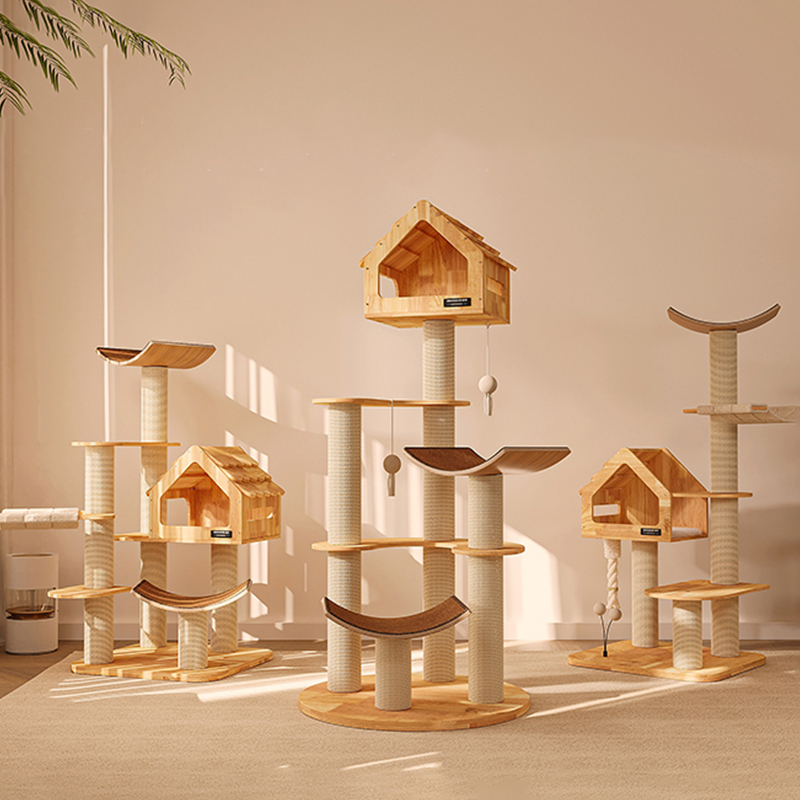
Forest Series cat trees with different heights and platform arrangements.
Yugie’s standard MOQ generally starts at 30–50 pieces per model, according to its supplied ordering information. Customized products can require higher quantities depending on materials and production complexity.
Ask the cat furniture supplier whether the minimum applies separately to each finish, fabric, structure or packaging version. Get a line-by-line quantity proposal; do not assume variants can be freely mixed.
Illustrative model count: three models at a confirmed 40-piece minimum require 120 pieces in total. The 40-piece figure is hypothetical, not a quotation.
Illustrative finish count: if each model has two separately counted finishes at that same minimum, the commitment could double to 240 pieces.
Solid wood trees: Yugie’s models may combine rubberwood, plywood, paper columns and sisal rope.
Metal trees: these combine carbon steel, solid wood and fabric.
Villas: these generally use rubberwood, plywood, tempered glass and carbon steel; review packing for the glass and frame parts.
Inspect the selected sample’s connections, finish, platform arrangement and assembly instructions rather than treating “solid wood” as a complete specification. These products are for indoor use and are not suitable for outdoor use.
A low MOQ reduces the number of units committed; it does not guarantee a lower unit price. Ask the cat tree manufacturer for the pilot price and the next quantity tier using the same specification. Separate development, samples and branded-packaging costs so a later repeat order can be compared fairly.
Request an itemized quote using actual carton dimensions, gross weight, destination and delivery point. Compare available consolidated sea freight or other shipping options with origin handling, destination charges and final delivery included. Minimum or fixed charges are spread across fewer units; a low ocean-freight headline alone is an incomplete budget.
Every input below is hypothetical. Replace it with the actual quotation. Duties, taxes, development and selling costs are excluded from this illustration.
Illustrative pilot cost calculation
Step | Calculation | Result |
|---|---|---|
Product cost | 40 units × $60 | $2,400 |
Add shipment and receiving | $2,400 + $1,000 | $3,400 total |
All 40 units saleable | $3,400 ÷ 40 | $85 per saleable unit |
Only 38 units saleable | $3,400 ÷ 38 | About $89.47 per saleable unit, before any recovery |
Cash budget: track the total committed to the experiment, including development, samples and branded packaging where applicable.
Unit-cost budget: divide the relevant landed costs by saleable units. Include inspection, storage, replacement handling and relevant import costs in the real calculation.
For wholesale cat furniture, keep the factory-to-warehouse cost separate from marketplace fees or retailer support. A larger order can distribute fixed costs more widely while committing more cash to unproven stock.
Keep structural development separate from the first demand test unless the new structure is the proposition being tested. A custom cat tree with changed dimensions, components and finish can need more sampling and a higher minimum. Changing everything together makes it difficult to identify which feature buyers valued or which change caused support problems.
Customization choices: Yugie’s OEM/ODM customization covers size, color, material selection, branding and packaging. Its service process includes design, sampling and confirmation before bulk production.
Production consistency: the company describes woodworking, metal-processing and upholstery machinery, with checks across production. Agree which sample features and components must remain consistent in the trial and repeat orders.
Yugie offers export cartons, retail color boxes, branded packaging and protective Amazon FBA packaging. Choose for the intended journey as well as brand presentation.
ISTA’s test-procedure overview distinguishes screening tests from simulations of transport hazards. Ask a packaging laboratory which evaluation suits the selected pack and distribution route; a packaging option alone does not establish marketplace compliance.
Retain the agreed material, finish, hardware and component list for the pilot configuration.
Review a packed sample, assembly instructions and parts identification before bulk packing.
Compare carton volume with protection for panels, glass where present, and loose hardware.
Confirm the same packaging specification and any required changes before reordering.
Collect the same information for each tested configuration. Define net sell-through as net units sold divided by saleable stock allocated to the test over the stated window. Keep display samples, damaged receipts and returns identifiable. Compare selling periods with similar availability and exposure; a stockout or an unlisted product cannot be read like fully available inventory.
Pilot signals and the decisions they support
Signal | What to record | How to interpret it |
|---|---|---|
Demand | Net sales, intended versus actual price, display/listing exposure, time in stock | Weak sales need an exposure and price check before rejecting the model. |
Returns | Count against sold units; separate fit/style, quality and other reasons | Healthy initial sales with concentrated returns can call for a product or expectation change. |
Transit damage | Damaged units against inspected receipts, affected parts and packaging photographs | Repair packaging or handling before attributing the problem to market demand. |
Assembly support | Queries against delivered units, missing-part reports, task and resolution time | Clarify instructions or parts organization; include the service burden in the next order. |
Retailer continuation | Requests for repeat stock plus actual retailer sales data | Separate willingness to restock from a one-time opening order. |
Use the brand’s own acceptance criteria; there is no universal sell-through, return or damage threshold for every channel. With a small batch, report counts alongside rates: one event among ten deliveries is 10%, but one event is limited evidence. Allow the relevant return period to mature and investigate causes before making a larger commitment. A quick sellout during a promotion may justify another controlled test rather than immediate expansion.
Decide the next commitment using sales progress, landed costs and the support pattern together. Record which conditions changed before treating a second batch as confirmation.
Stop: demand stays weak after credible exposure, or the economics exceed the brand’s test budget.
Revise: a specific finish, instruction, packing or positioning problem can be changed and retested.
Reorder: the same configuration meets the buyer’s criteria, but more comparable selling data is needed.
Scale: demand and fulfillment remain acceptable across repeat observations; expand quantity or another market deliberately.
Plan replenishment from the date replacement stock must be saleable. Yugie’s typical production range is 30–45 days, depending on quantity and customization; standard repeat orders may be shorter. Add approval, inspection, freight, customs and receiving time to the plan. Compare that full interval with remaining saleable stock divided by an observed weekly sales rate. If cover is too short, agree a smaller repeat, availability gap or revised launch schedule rather than assume low MOQ means immediate replenishment.
No. A sample checks the selected product and packing before the demand test. For an OEM cat tree, review the approved configuration and instructions separately from the decision about how much trial stock to buy.
Yugie states that sample fees can be refunded or deducted after a bulk order. Confirm whether the proposed pilot qualifies, which design the deduction applies to, and the freight treatment in writing.
Keep the initial results separate by destination and channel. Different pricing, promotion, delivery conditions and return policies can obscure the reason for a result; expand after the first market produces interpretable evidence.
Yugie describes replacement solutions and compensation for confirmed transit damage, with optional shipping insurance. Agree the claim documents, timing, replacement freight and remedy scope before dispatch; keep damage claims separate from demand-related returns.
Exclusivity is a separate discussion. Yugie says exclusive projects can be considered through patents or exclusive agreements; define the products, territory, duration and rights involved rather than assume the order grants worldwide protection.
Send the pet furniture manufacturer one destination, one channel, the shortlisted configurations and quantities, and the intended selling window. Ask Yugie to confirm model and variant minimums, packing details, an itemized quotation under the agreed freight term, and repeat-order timing.
Use that proposal to fund a bounded pilot, then choose the next order from measured sales, delivery and assembly results.


