

Views: 0 Author: Site Editor Publish Time: 2026-08-25 Origin: Site


A noticeable gap exists between standard retail pet furniture and premium designer lines. For brand owners and B2B buyers, aesthetics alone cannot sustain a premium price point. Structural integrity and material quality remain the true differentiators in this market. We see a rapidly rising consumer demand for pet furniture today. People want pieces blending seamlessly into modern home decor while withstanding heavy daily use. This holds especially true for large breeds and multi-cat households requiring immense stability.
Producing a market-leading Designer Cat Tree relies on rigorous evaluation of load-bearing substrates and non-toxic textiles, as well as stable, professional OEM/ODM manufacturing partnerships for standardized mass production. Mastery of these core production and sourcing elements minimizes terminal return rates and effectively safeguards brand market credibility. Focused optimization of structural engineering and material selection delivers long-lasting product performance and consistent consumer satisfaction, building solid market competitiveness for premium pet furniture brands.
Material Lifespan dictates Brand Value: Commercial-grade sisal (minimum 6mm-8mm) and heavy-duty structural substrates reduce the shedding and wobbling issues common in mass-market products.
Compliance is Non-Negotiable: Using CARB P2 or EPA TSCA Title VI compliant engineered woods and non-toxic adhesives shields your brand from liability and consumer backlash.
Balancing Weight and Logistics: Premium materials increase base stability but directly impact shipping costs. Evaluating the strength-to-weight ratio is a critical manufacturing decision.
Supplier Capabilities: A reliable manufacturer must provide transparent QC protocols, verifiable material certifications, and scalable MOQs.
Excessively high return rates severely erode profit margins in the premium pet furniture sector. Negative user-generated content acts as a critical market deterrent for potential consumers. Public consumer feedback frequently mentions structural wobbling, pillar fracture, and severe fiber shedding on mid-to-low-end pet furniture. Recurring product quality issues rapidly weaken overall market trust in pet furniture brands. Consumers willing to invest in high-end pet products expect furniture-grade stability and durability. Premature product failure causes quantifiable damage to brand reputation and long-term market influence.
Durable designer pet furniture is defined by core structural and material performance, rather than superficial exterior aesthetics. Professional quality assessment focuses on material density and overall weight-bearing capacity. Premium brand operation requires standardized product evaluation criteria grounded in the following core metrics:
High Weight Capacity: A true premium piece should support 20 or more pounds per platform without stressing the structural joints.
Kinetic Stability: The unit must resist tipping when an energetic cat leaps onto the highest perch.
Surface Resilience: Scratching posts must endure months of aggressive use before showing significant fraying.
Scientific cost-value balance is essential for sustainable brand profitability. Upgrading to commercial-grade components increases upfront BOM costs, yet the quality upgrade drastically reduces after-sales service pressure and repeated replacement part logistics expenses. In the long run, high-standard material configuration optimizes comprehensive profit margins and consolidates stable consumer loyalty for premium pet furniture brands.
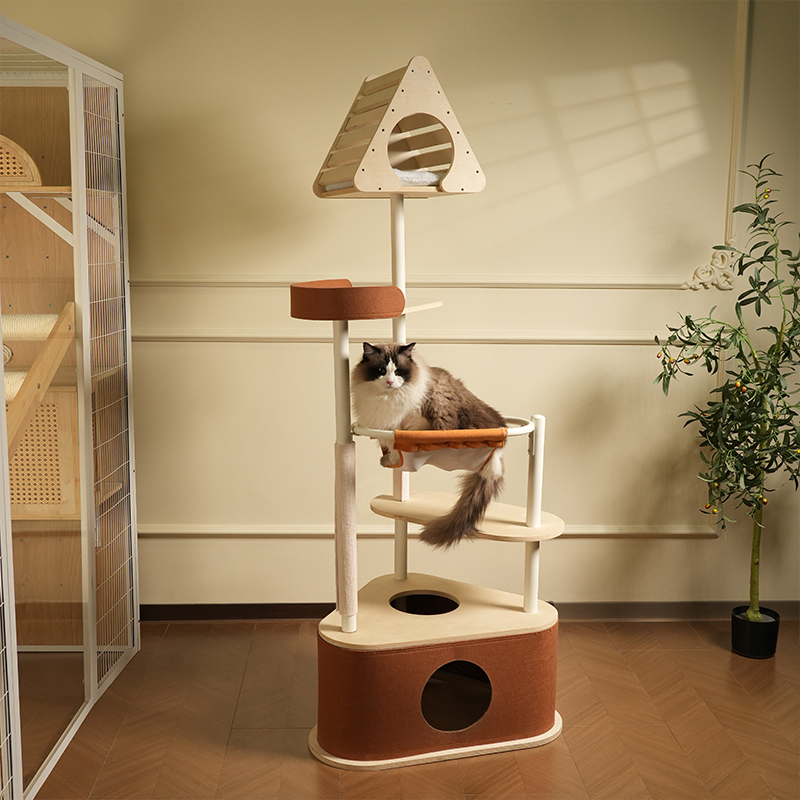
Selection of foundational substrate materials directly determines overall product durability. High-quality solid wood options including oak, pine, and Baltic birch plywood deliver outstanding structural stability and premium visual texture. Solid wood features excellent natural moisture resistance and high-end tactile perception, perfectly matching premium designer product positioning.
Solid wood materials also bring inherent trade-offs for manufacturing and wholesale operations. High raw material costs and heavy product weight raise overall production and logistics expenses. Unprocessed solid wood faces structural warping risks in variable humidity environments. Professional manufacturers strictly control wood moisture content through standardized kiln drying processes to avoid post-assembly deformation, serving as a key verification indicator for B2B procurement audits.
Premium engineered wood materials such as high-density MDF and particleboard serve as scalable, cost-effective alternatives for mass production. These materials feature uniform panel texture and smooth surfaces, enabling seamless veneer and surface wrapping processing. Procurement teams must strictly select high-density engineered wood variants while completely avoiding low-grade particleboard. Inferior particleboard structures easily crumble at hardware connection points under long-term vibration and impact from pet activities, causing screw loosening and structural instability.
Safety compliance standards constitute core competitive advantages for premium products. CARB Phase 2 and EPA TSCA Title VI certifications ensure ultra-low formaldehyde emissions for wood substrates and adhesives. Strict safety compliance caters to modern consumer demands for indoor air quality and eco-friendly home products, forming credible market selling points for high-end pet furniture.
Material Type | Primary Advantages | Notable Trade-offs | Best Application |
|---|---|---|---|
Solid Hardwood (Oak/Ash) | Maximum durability, premium aesthetic, high moisture resistance | Very high cost, heavy shipping weight, warping risks | Ultra-premium, low-volume designer lines |
Birch Plywood | Excellent strength-to-weight ratio, screw retention, minimal warping | Moderate to high material cost | Commercial-grade multi-level towers |
High-Density MDF | Consistent uniformity, perfectly smooth for veneers, cost-effective | Heavier than plywood, vulnerable to standing water | Mid-to-high tier stylish home integrations |
A well-built Designer Cat Tree needs robust scratching materials. Common options include sisal, jute, and seagrass. Tensile strength varies wildly between these natural fibers. We recommend 6mm to 8mm natural woven sisal rope. This specific thickness provides genuine commercial durability. It withstands aggressive scratching from large cat breeds.
Fiber shedding remains a prevalent terminal consumer pain point, solvable through standardized factory processing techniques. Professional manufacturers adopt fully glued, machine-wound sisal construction instead of basic staple fixation. Uniform high-tension machine winding effectively prevents strand unraveling and reduces scattered fiber shedding, optimizing terminal user experience.
Pet furniture upholstery materials are undergoing industrial upgrading, phasing out traditional faux fur and low-cost carpet fabrics that easily trap bacteria, absorb odors, and shed excessively. Modern premium designer pet furniture adopts high-standard textiles including heavy-duty boucle, durable canvas, and ultra-soft microfiber, balancing aesthetic integration and daily practicality.
Scientific structural design optimizes fabric service cycle and commercial value. Velcro-attached, fully detachable machine-washable fabric components extend overall product service life significantly. Local fabric contamination or wear no longer requires full product replacement, only independent cleaning or part replacement. Additionally, detachable replacement cushions create effective upsell opportunities, supporting brand secondary revenue growth and user repurchase stickiness.
Hidden safety risks exist in poor manufacturing processes. Consumers grow increasingly skeptical of strange chemical smells during unboxing. Evaluate the urgent transition to water-based, non-toxic, and pet-safe adhesives. This single change eliminates toxic off-gassing and boosts customer satisfaction reviews instantly. We strongly suggest asking manufacturers for material safety data sheets (MSDS) regarding all factory glues.
Fasteners directly impact overall base stability. The base plate represents the heaviest and most crucial component of the unit. We recommend specifying a pillar diameter greater than 9cm for large breeds. Thick pillars prevent swaying.
Proper hardware requirements involve metal-to-metal threading. Manufacturers typically achieve this using embedded threaded inserts and machine bolts. Avoid cheap wood screws entirely. They strip the surrounding wood easily after just one assembly and disassembly cycle. When owners move houses, they need furniture they can safely dismantle and rebuild.
Center of gravity calculations prevent dangerous tipping accidents. Manufacturing importance hinges on rigorous CAD testing. This structural testing determines tipping thresholds accurately. It proves especially vital for tall, multi-level tower designs.
Best Practice: Keep the heaviest components near the floor.
Best Practice: Ensure the base plate footprint is at least 30% wider than the highest perch.
Common Mistake: Using lightweight particle board for the base while mounting heavy wooden boxes at the top.
In-depth verification of factory production capacity is the core step of supplier screening. Advanced in-house wood CNC machining equipment ensures seamless component splicing and smooth edge polishing. Integrated textile wrapping and custom mold development capabilities reflect true ODM strength. Factories limited to basic white-label finished product customization cannot support brand differentiated design demands, while professional OEM/ODM partners realize full-process customized development from original concept design to mass production.
Transparent and standardized QC systems guarantee batch product stability. Formal cooperative suppliers provide full-link raw material sourcing records, professional load-bearing test reports, and complete pre-shipment inspection documents. Active disclosure of internal defect rates and continuous quality improvement mechanisms serve as key indicators of reliable long-term cooperative factories.
Logistics planning and MOQ policies directly affect brand inventory and capital operation strategies. Overseas manufacturing features low unit costs and large-scale production capacity, while localized manufacturing shortens delivery cycles, reduces carbon emissions, and supports regional market brand marketing. Reasonable selection of production bases balances cost efficiency and market response speed.
Early confirmation of customized MOQ rules avoids cooperative barriers. Most professional factories set 100–500 unit minimum order quantities for new customized production lines. Meanwhile, optimized flat-pack packaging design reduces overall shipping volume, eliminates oversize logistics surcharges, and improves overall freight cost control for wholesale orders.
Premium pet furniture sourcing requires balanced optimization of aesthetic design, pet safety performance, and structural engineering science. High-quality substrates and eco-friendly textiles fundamentally avoid product failure risks and differentiate premium brand products from low-end disposable alternatives. Core configurations including metal-to-metal hardware structures and machine-wound sisal ensure long-term product durability. Detachable and washable fabric designs improve terminal hygiene experience and create sustainable secondary revenue channels for brands.
Standardized supply chain management stabilizes long-term brand development. Procurement teams are advised to collect complete raw material spec sheets and compliance certificates such as CARB and FSC files to verify product safety and environmental performance. Physical prototype testing from shortlisted manufacturers is mandatory before large-scale mass production, ensuring all products meet brand’s strict quality and design standards.
A:Most Yugie cat furniture is made from solid rubberwood, carbon steel frames, and natural scratching materials such as jute rope or kraft paper rope. These materials provide long-term durability while maintaining a premium appearance suitable for modern interiors.
A: Baltic birch plywood or high-density MDF (CARB P2 compliant) offer the best balance. They provide exceptional strength, manageable weight, and reasonable cost. Birch plywood holds screws securely, while high-density MDF offers a perfectly smooth surface for premium wood veneers.
A: Commercial-grade products require a minimum sisal thickness of 6mm to 8mm, with full-process machine winding and full-surface glue reinforcement. High-tension machine winding effectively prevents strand loosening and unraveling, greatly reducing terminal fiber shedding compared with traditional staple fixation methods.
A: Qualified OEM partners must provide verifiable non-toxic material certifications and mature flat-pack structural design solutions to reduce logistics costs. Complete QA systems with standardized structural load testing before delivery are essential to ensure batch product stability.


