

Views: 0 Author: Site Editor Publish Time: 2026-08-14 Origin: Site


A Designer Cat Tree represents a high-value furniture investment for residential spaces. Modern aesthetics effectively resolve indoor visual clutter issues. However, market feedback proves many premium-looking products lack reliable core quality. Sleek exterior design does not equate to solid structural performance, and high retail pricing cannot guarantee long-term durability. Product service life is entirely determined by base materials, precise joinery craftsmanship, and scientific weight distribution structure. This guide provides a professional evaluation framework for wholesale procurement teams, helping inspect structural engineering standards and raw material quality of premium cat trees before bulk orders. Standardized quality assessment mechanisms ensure procured products deliver far longer service life than ordinary retail-grade alternatives. Professional inspection of wood grades and non-toxic adhesive compliance helps businesses avoid disposable decorative products disguised as high-end furniture. This article comprehensively analyzes core hardware standards and key evaluation metrics for sourcing truly durable premium pet furniture.
Structure Over Surface: Solid hardwood or high-density Birch plywood drastically outperforms standard MDF in fastener retention and moisture resistance.
Scratch Surface ROI: Modular, tightly woven sisal (not twisted rope) extends the usable life of the unit and prevents full-unit replacements.
The Weight Rule: True durability in a designer cat tree correlates heavily with base weight and center of gravity, especially for large breeds.
Compliance Matters: Premium choices should explicitly state compliance with non-toxic adhesive standards (e.g., CARB Phase 2) to prevent VOC off-gassing.
Minimalist home decor often struggles against high-impact behavior. Cats sprint vertically up posts. They jump forcefully from high ledges. They scratch vigorously to shed claw sheaths. Modern furniture lines push for sleek silhouettes. These aesthetic choices frequently conflict directly against a cat's instinctual physical needs. A slim profile looks beautiful in a living room. However, it rarely provides enough resistance for an adult cat stretching fully.
Imitation products with superficial aesthetics create serious market pitfalls for bulk procurement. Many manufacturers adopt ultra-thin wood veneers covering low-grade particleboard cores to simulate high-end designer furniture textures. This cost-cutting production process leads to structural joint failure within 6–12 months of terminal use. The loose composite core collapses under long-term jumping pressure, causing hardware detachment and continuous structural shaking after assembly, resulting in severe after-sales risks for retailers and distributors.
Genuine premium pet furniture delivers stable long-term commercial value. Despite higher upfront procurement costs, qualified products maintain intact structural performance for more than five years without deformation or damage, eliminating long-term safety hazards. Precise joinery technology avoids structural shaking, and high-density core materials resist moisture erosion and impact damage. Qualified premium products withstand long-term daily use and maintain stable performance, supporting sustainable retail sales and brand reputation maintenance.
In-depth core material inspection serves as the core link of wholesale quality control. Solid hardwood materials deliver outstanding structural strength, with oak, birch, and maple as mainstream high-end options. Solid wood features excellent hardware fastening performance, with natural grain structures firmly locking assembly accessories. Hardwood materials resist daily moisture and ambient humidity erosion and support long-term stable use for large-sized pets.
Solid wood products also have inherent characteristics worthy of procurement attention. Solid wood materials increase overall product weight, leading to higher logistics and transportation costs. Unsealed hardwood surfaces are prone to scratching and gouging during daily use, requiring standardized surface finishing processes from manufacturers.
High-quality engineered wood serves as another reliable solution for premium pet furniture production. Procurement teams need to strictly distinguish high-density multi-layer birch plywood from ordinary MDF materials. Multi-ply birch plywood adopts cross-grain lamination technology to effectively prevent structural warping and deformation, delivering stable and durable performance suitable for modern curved design structures. Standard MDF and low-density particleboard must be avoided for load-bearing parts, as these materials easily crumble at connection points under long-term dynamic pressure, causing structural failure.
Assembly process standards determine the ultimate service life of composite materials. Individual manufacturers apply MDF to non-load-bearing auxiliary components. In such cases, standardized hardware configuration must be verified. Formal manufacturers adopt reinforced metal thread inserts for assembly instead of direct wood screw fixing on composite materials. Metal inserts evenly disperse structural pressure, effectively improving overall stability and helping reduce stability-related after-sales complaints.
Material Durability Comparison Chart
Material Type | Fastener Retention | Moisture Resistance | Weight Threshold | Best Use Case |
|---|---|---|---|---|
Solid Hardwood (Oak/Birch) | Excellent | High (if sealed) | Very High | Premium heirloom pieces, heavy breeds |
High-Density Plywood | Very Good | Moderate-High | High | Stable platforms, modern curved designs |
Standard MDF / Particleboard | Poor | Low (swells easily) | Low-Moderate | Avoid for load-bearing joints |
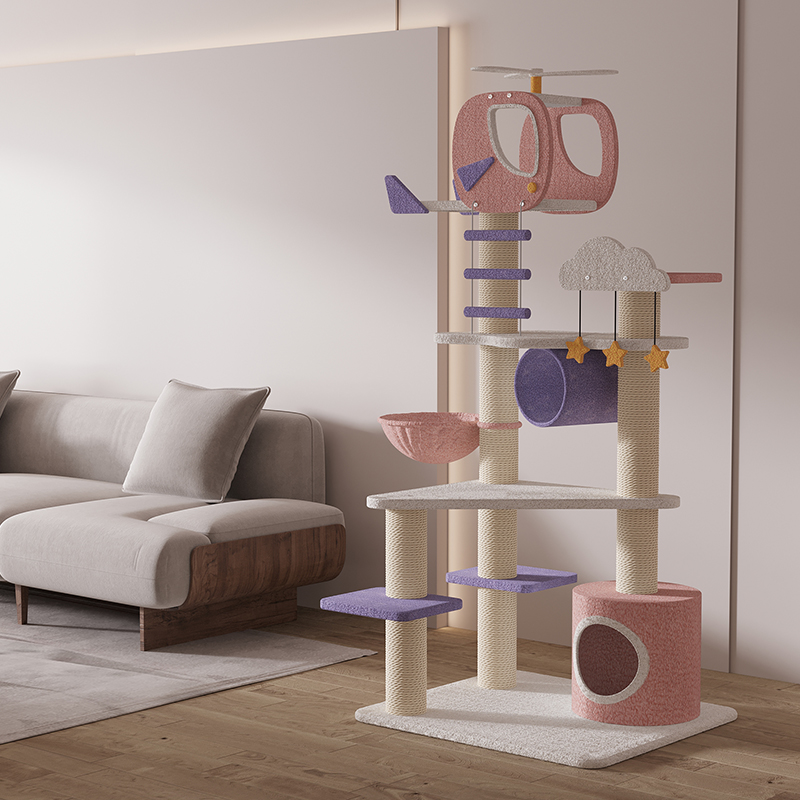
Woven sisal fabric outperforms traditional twisted sisal rope in long-term durability, making it the preferred material for high-end designer cat trees. Woven sisal mats effectively resist fraying and deformation during long-term scratching friction. Traditional coiled twisted rope suffers from overall unspooling damage once local strands break, requiring full product replacement. The integrated structure of woven sisal concentrates wear on local areas, maintaining overall structural integrity and neat appearance for a longer service cycle.
Material thickness and fixing processes are key inspection indicators for wholesale procurement. Premium-grade sisal materials feature a minimum thickness of 3/8 inch with uniform density and strong friction resistance. Formal manufacturers adopt recessed stapling or full-surface even non-toxic glue bonding processes, avoiding exposed sharp metal parts and ensuring safe and durable material fixation.
The modular advantage defines a true Designer Cat Tree. Prioritize products with independently replaceable scratching columns and peel-and-stick sisal pads. Non-modular integrated structures require full product replacement once local scratching surfaces wear out, increasing terminal use costs and waste. Modular detachable structures support independent replacement of worn parts, reducing terminal maintenance costs and improving product sustainability, while enriching merchants’ after-sales service and secondary profit categories.
Pet jumping and climbing behaviors generate powerful lateral kinetic impact force, which is fully borne by cat tree structures. Products with insufficient structural mass and base stability face tipping risks during daily use, causing safety hazards and after-sales disputes.
Base plate configuration is the core of structural stability. Qualified premium cat tree bases account for 30% to 40% of the total product weight, with a wide and flat footprint design. Narrow and stylized bases sacrifice stability for appearance, failing to resist lateral impact during pet activities. A reasonable wide-footprint structure effectively anchors the overall unit and ensures stable operation during rigorous daily play.
Center of gravity design determines the safety performance of multi-layer high-rise cat trees. Tall multi-tiered products adopt offset platform layout to evenly disperse vertical pressure and balance overall weight, forming a stable stepped climbing structure and avoiding overall tilting caused by unbalanced force.
High-rise products over 60 inches require enhanced safety configuration. Standardized factory designs support matching hidden wall anchoring accessories, assisting in structural fixation and eliminating tipping risks, which is an essential safety configuration for high-rise premium pet furniture.
Best Practices for Stability Checking:
Perform the lateral push test on the top tier before buying.
Ensure the base footprint exceeds twenty-four inches in width.
Verify weight capacities per platform exceed thirty pounds.
Confirm all vertical load-bearing posts measure at least four inches in diameter.
Chemical safety certification is an important symbol of formal manufacturer strength and product premium positioning. Wholesale procurement needs to prioritize products compliant with CARB Phase 2 and TSCA Title VI standards. These certifications strictly limit formaldehyde and VOC emissions of adhesives and paints. Since indoor pet furniture has long-term contact with living environments, low-emission and non-toxic materials effectively avoid respiratory health risks caused by long-term harmful gas volatilization. Formal manufacturers fully adopt water-based environmental protection varnishes for wood components to ensure indoor environmental safety.
Cleaning and maintenance performance determines product long-term usability and terminal repurchase rates. Fully glued fixed plush fabrics should be completely avoided in bulk procurement. Integrated glued structures easily trap dander, stains, and bacteria, failing to achieve deep cleaning and causing permanent odor residue, which reduces terminal user experience.
High-maintenance-standard premium products adopt detachable machine-washable cushion designs. Heavy-duty snaps and industrial Velcro are used for fixed installation, matching sealed and wipeable wood base surfaces. The split structure supports independent cleaning of fabric accessories and direct wiping of wood structures, effectively avoiding permanent stains and improving product reusable cycles.
Product weight serves as an intuitive screening indicator for material density and structural quality. Comparing shipping weights of alternative models helps quickly identify product quality differences. Heavier product weight corresponds to denser raw materials and more solid structures. Lightweight high-rise cat trees usually adopt hollow tubes and low-cost auxiliary materials, with poor stability and durability.
Warranty policies and replacement part service systems reflect manufacturers’ confidence in product quality. Reliable B2B manufacturers provide at least one-year structural component warranty services. Complete transparent pricing and stable supply of replacement parts prove product durable design positioning and long-term production strength, supporting terminal product long-term use for up to a decade.
Professional procurement decisions require systematic scoring and screening based on four core dimensions:
Frame material quality and core density.
Modularity of high-wear parts like scratching posts.
Base stability and overall footprint width.
Ease of cleaning and cushion removability.
Premium pet furniture procurement value lies in matching high-end appearance with reliable internal craftsmanship and material quality. Procurement teams need to ignore superficial aesthetic design and focus on transparent wood grade parameters, non-toxic adhesive certification, and structural load-bearing standards. Exquisite veneer decoration cannot compensate for defective core materials and unstable structures. Qualified premium designer cat trees adopt solid hardwood or multi-layer birch plywood structures, paired with modular detachable designs and safe environmental protection processes, ensuring terminal use safety and long-term durability. Strict engineering standard screening helps merchants select high-quality products that balance interior aesthetic matching and practical use performance, creating stable profitable product lines for premium pet retail markets.
A: A structurally sound tree made of solid wood or high-grade plywood should last 5-10 years, assuming the scratching surfaces are replaceable. Lower-grade models typically fail within the first year under heavy use.
A: Generally, yes, due to better fastener retention and moisture resistance. However, high-density, furniture-grade plywood is an equally durable and often more climate-stable alternative to solid wood. Always avoid standard MDF for load-bearing joints.
A:Yes. Yugie specializes in OEM and ODM services. Our design team can develop customized cat trees, cat villas, or bird cages based on your brand requirements, including size adjustments, color options, logo placement, and packaging design.
A: Look for three metrics: a total weight exceeding 50 lbs, a base width of at least 24 inches, and clearly stated weight capacities per platform (ideally 30+ lbs per level). Wide bases prevent dangerous tipping.
A: Product modular design varies by manufacturer. High-quality premium designer cat trees adopt detachable and replaceable scratching post structures, supporting independent replacement of worn parts without overall product elimination. Bulk procurement needs to verify the brand’s complete replacement part supply system in advance to guarantee long-term terminal product maintenance performance.


